PUBLISHED March 27, 2026
According to the latest forecast published by the Swedish Association of Local Authorities and Regions (SKR), Sweden’s economy is now clearly on its way out of the recent downturn. After several years of weak growth, new projections indicate that economic activity is beginning to strengthen, marking a potential turning point in the country’s economic cycle.
Following a period of subdued performance, the economic outlook for 2026 and 2027 appears more positive. The recovery is expected to gain momentum, driven primarily by increasing household consumption. This development is supported by a more expansionary economic policy environment and a reduction in uncertainty related to international trade tensions, which had previously weighed on economic confidence.
Economic Confidence Gradually Improves
In parallel with the improving growth outlook, economic sentiment indicators are also showing gradual improvement. Businesses and households are becoming more optimistic about future developments, reflecting easing financial pressures and a more predictable economic environment. This shift in confidence is considered an important factor supporting the recovery, as it can encourage both consumption and investment decisions in the coming period.
The labour market is also showing signs of recovery, with employment levels rising and cyclical unemployment beginning to decline. However, structural challenges remain, particularly in terms of matching available jobs with job seekers. As highlighted in the SKR report, this indicates a continued need for active labour market policies to ensure that improvements in economic conditions translate into broader employment gains.
An important consequence of the improving economic situation is the development of the tax base, which is expected to grow in the coming years. According to SKR, this increase will provide some relief for municipalities and regions, which have faced financial pressure in recent periods. The forecast suggests that the tax base will be slightly higher than previously expected, reflecting stronger overall economic activity.
According to the latest forecast published by the Swedish Association of Local Authorities and Regions (SKR), Sweden’s economy is now clearly on its way out of the recent downturn. After several years of weak growth, new projections indicate that economic activity is beginning to strengthen, marking a potential turning point in the country’s economic cycle.
Following a period of subdued performance, the economic outlook for 2026 and 2027 appears more positive. The recovery is expected to gain momentum, driven primarily by increasing household consumption. This development is supported by a more expansionary economic policy environment and a reduction in uncertainty related to international trade tensions, which had previously weighed on economic confidence.
Economic Confidence Gradually Improves
In parallel with the improving growth outlook, economic sentiment indicators are also showing gradual improvement. Businesses and households are becoming more optimistic about future developments, reflecting easing financial pressures and a more predictable economic environment. This shift in confidence is considered an important factor supporting the recovery, as it can encourage both consumption and investment decisions in the coming period.
The labour market is also showing signs of recovery, with employment levels rising and cyclical unemployment beginning to decline. However, structural challenges remain, particularly in terms of matching available jobs with job seekers. As highlighted in the SKR report, this indicates a continued need for active labour market policies to ensure that improvements in economic conditions translate into broader employment gains.
An important consequence of the improving economic situation is the development of the tax base, which is expected to grow in the coming years. According to SKR, this increase will provide some relief for municipalities and regions, which have faced financial pressure in recent periods. The forecast suggests that the tax base will be slightly higher than previously expected, reflecting stronger overall economic activity.
In addition to economic growth, inflation is expected to be lower than previously estimated, which could contribute to improved purchasing power. This development is particularly significant for the public sector, as it allows for better financial conditions in the medium term. By 2027, these combined effects are expected to lead to a modest strengthening of financial capacity within municipalities and regional governments.
Despite the positive outlook, the recovery is not without its challenges. Structural unemployment remains an issue, and not all segments of the labour market are benefiting equally from the improving economic conditions. This highlights the uneven nature of the recovery and the importance of targeted policy measures to address long-term imbalances.
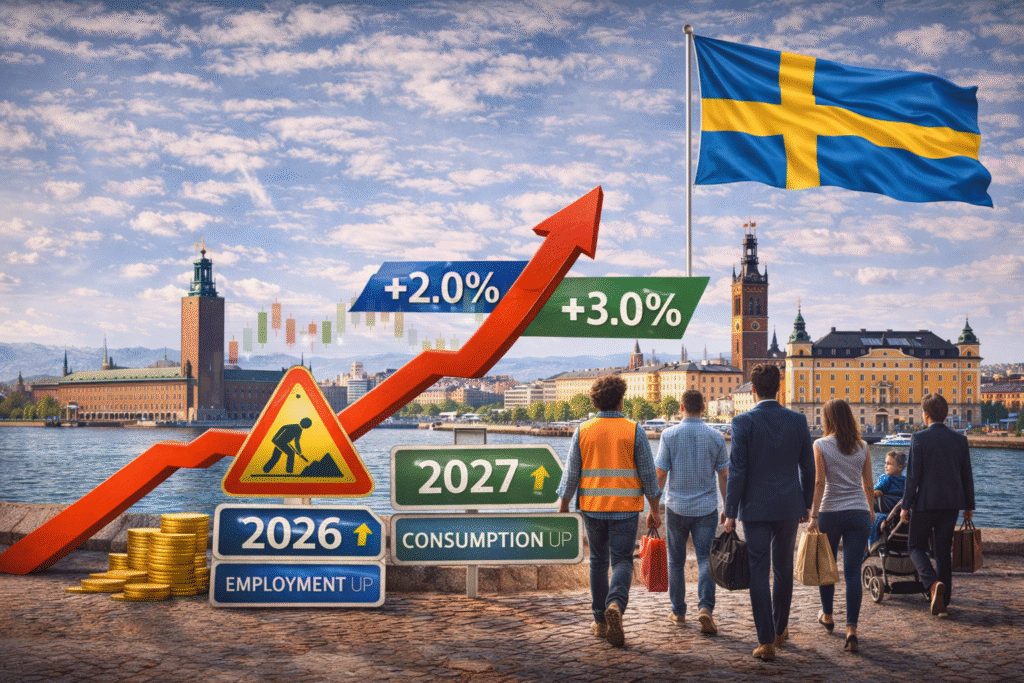
Overall, the SKR forecast suggests that Sweden is entering a phase of gradual recovery rather than experiencing a rapid economic rebound. The combination of rising employment, increasing consumption, and a stronger tax base points toward a more stable outlook, although continued policy support will be necessary to sustain the positive trend.
In addition to economic growth, inflation is expected to be lower than previously estimated, which could contribute to improved purchasing power. This development is particularly significant for the public sector, as it allows for better financial conditions in the medium term. By 2027, these combined effects are expected to lead to a modest strengthening of financial capacity within municipalities and regional governments.
Despite the positive outlook, the recovery is not without its challenges. Structural unemployment remains an issue, and not all segments of the labour market are benefiting equally from the improving economic conditions. This highlights the uneven nature of the recovery and the importance of targeted policy measures to address long-term imbalances.
Overall, the SKR forecast suggests that Sweden is entering a phase of gradual recovery rather than experiencing a rapid economic rebound. The combination of rising employment, increasing consumption, and a stronger tax base points toward a more stable outlook, although continued policy support will be necessary to sustain the positive trend.