Danish Economy Shows Signs of Diverging Growth Patterns
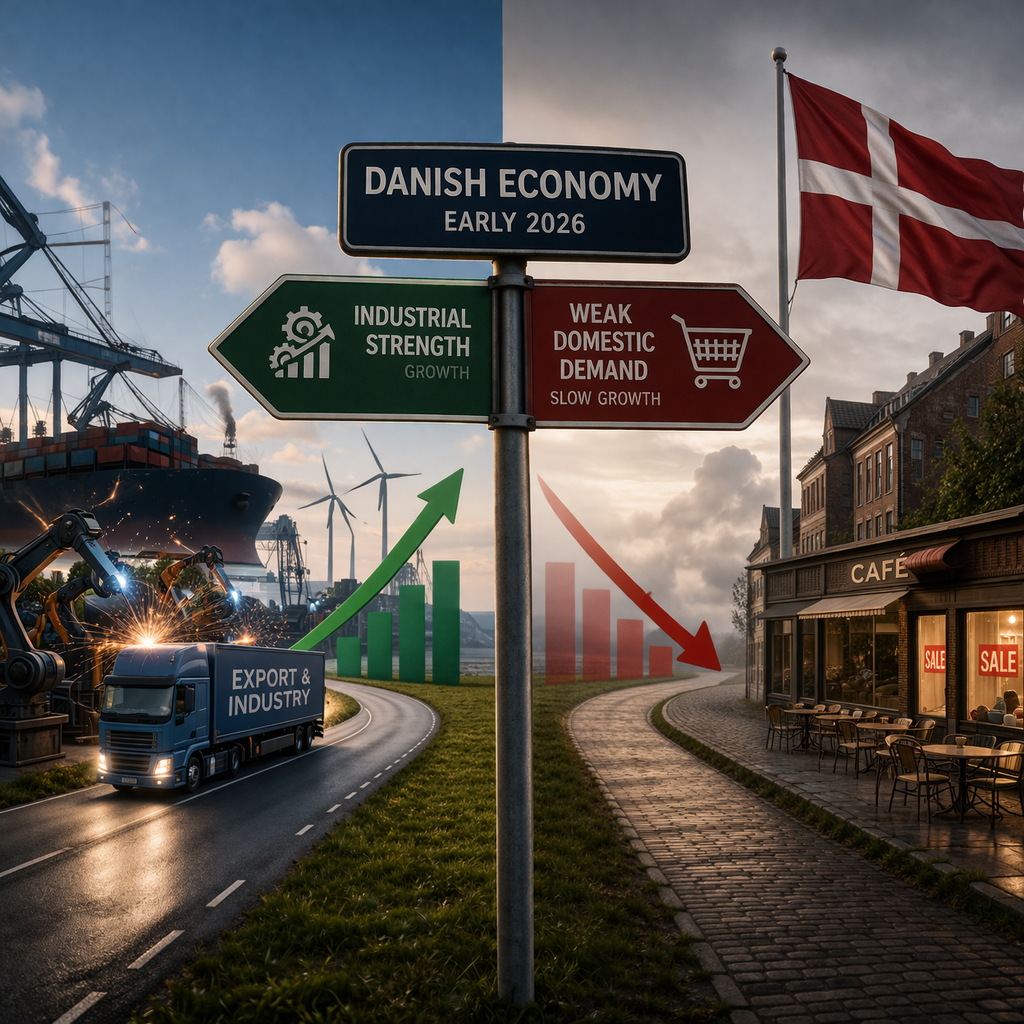
Industrial Strength Contrasts with Weak Domestic Demand in Early 2026
Danish Economy Shows Signs of Diverging Growth Patterns
Industrial Strength Contrasts with Weak Domestic Demand in Early 2026
PUBLISHED March 27, 2026
Economic Developments Reflect Mixed Trends
According to data published by Statistics Denmark, the Danish economy is currently characterised by diverging developments across sectors, with some areas showing solid growth while others remain under pressure. The latest figures indicate that overall economic activity is not moving uniformly, highlighting a complex and uneven economic environment.
Industrial Sector Continues to Support Growth
A key driver of economic performance remains the industrial sector, which continues to show relatively strong results. Production and exports contribute significantly to overall growth, underlining the importance of Denmark’s internationally oriented industries. This strength provides an important counterbalance to weaker developments in other parts of the economy.
Domestic Demand Remains Subdued
In contrast to industrial activity, domestic demand continues to show signs of weakness. Household consumption has not fully recovered, reflecting cautious behaviour among consumers. This subdued demand limits broader economic momentum and contributes to the uneven nature of the current recovery.
Labour Market Shows Relative Stability
Despite mixed economic signals, the labour market remains relatively stable. Employment levels have not experienced significant deterioration, which helps support overall economic resilience. However, the stability of the labour market alone is not sufficient to drive strong economic expansion.
Labour Market Shows Relative Stability
Despite mixed economic signals, the labour market remains relatively stable. Employment levels have not experienced significant deterioration, which helps support overall economic resilience. However, the stability of the labour market alone is not sufficient to drive strong economic expansion.
Investment Activity Remains Uncertain
Investment developments present another area of uncertainty. While some sectors continue to invest, overall investment activity remains cautious, influenced by economic uncertainty and external factors. This hesitation further contributes to the moderate pace of economic development.
External Factors Continue to Influence the Outlook
Denmark’s open economy remains highly sensitive to international developments, including global demand and trade conditions. External factors therefore continue to play a decisive role in shaping economic performance, reinforcing the importance of global economic stability.
Outlook: Uneven Growth Expected to Continue
Overall, the data suggests that Denmark’s economy is developing along an uneven path, with strong industrial performance offset by weaker domestic demand. The coming period will be crucial in determining whether internal demand can strengthen and support a more balanced and sustainable growth trajectory.
Investment Activity Remains Uncertain
Investment developments present another area of uncertainty. While some sectors continue to invest, overall investment activity remains cautious, influenced by economic uncertainty and external factors. This hesitation further contributes to the moderate pace of economic development.
External Factors Continue to Influence the Outlook
Denmark’s open economy remains highly sensitive to international developments, including global demand and trade conditions. External factors therefore continue to play a decisive role in shaping economic performance, reinforcing the importance of global economic stability.
Outlook: Uneven Growth Expected to Continue
Overall, the data suggests that Denmark’s economy is developing along an uneven path, with strong industrial performance offset by weaker domestic demand. The coming period will be crucial in determining whether internal demand can strengthen and support a more balanced and sustainable growth trajectory.
Follow us on LinkedIn!
Follow us on LinkedIn!
Would you like to sell your products or services worldwide?
Schedule an appointment with our international sales team
Would you like to sell your products or services worldwide?
Schedule an appointment with our international sales team