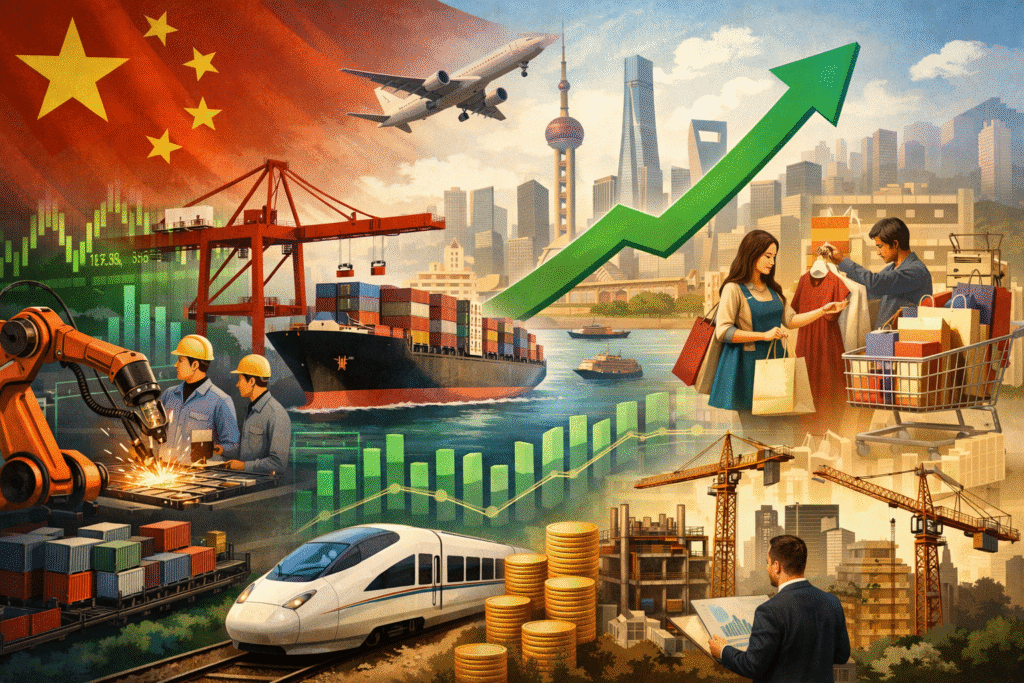
Industrial Growth and Exports Lead While Domestic Demand Remains Uneven
China’s Economy Shows Strong Start to 2026
Industrial Growth and Exports Lead While Domestic Demand Remains Uneven
PUBLISHED March 27, 2026
Stronger-Than-Expected Start to the Year
According to Asianews Network, China’s economy began 2026 with better-than-expected performance, as key indicators exceeded market expectations in the first two months of the year. This strong start provides a solid foundation for achieving annual growth targets and signals resilience in the world’s second-largest economy.
Industrial Output and Manufacturing Drive Growth
A major contributor to this performance has been industrial production,
which recorded solid growth, supported by manufacturing activity and especially high-tech sectors. Industries such as electronics, machinery and transportation equipment played a key role, reflecting ongoing industrial upgrading and technological development.
Exports Remain a Key Growth Engine External demand continues to support the economy, with export-related manufacturing helping offset weaknesses in other areas.
This highlights China’s continued reliance on global markets, particularly in sectors linked to advanced production and technology.
Consumption Shows Signs of Recovery Retail sales improved compared to previous periods, supported in part by seasonal spending. However, while consumption has picked up, it has not yet become a strong and consistent driver of growth, suggesting that household demand remains cautious.
Investment Stabilises After Previous Weakness
Investment activity has also shown signs of recovery, reversing earlier declines. This improvement is partly linked to policy support and infrastructure-related spending, indicating that government measures continue to play an important role in sustaining economic momentum.
Investment Stabilises After Previous Weakness
Investment activity has also shown signs of recovery, reversing earlier declines. This improvement is partly linked to policy support and infrastructure-related spending, indicating that government measures continue to play an important role in sustaining economic momentum.
Challenges and Structural Pressures Remain
Despite the strong start, the economy still faces multiple challenges, including external uncertainties, geopolitical risks and ongoing structural issues such as weaknesses in the property sector and private demand. These factors suggest that the recovery remains uneven and dependent on policy support.
Potential Impact on Economic Balance
The current trend points to an imbalance between strong supply-side performance and weaker demand. If growth continues to rely mainly on industry and exports, the economy may face difficulties in achieving a more sustainable, consumption-driven model in the long term.
Outlook: Solid Start with Uneven Recovery Path
Overall, China has entered 2026 with strong momentum, but the sustainability of growth will depend on strengthening domestic demand. Without this shift, the economy may continue to expand, but with increasing structural imbalances.
Challenges and Structural Pressures Remain
Despite the strong start, the economy still faces multiple challenges, including external uncertainties, geopolitical risks and ongoing structural issues such as weaknesses in the property sector and private demand. These factors suggest that the recovery remains uneven and dependent on policy support.
Potential Impact on Economic Balance
The current trend points to an imbalance between strong supply-side performance and weaker demand. If growth continues to rely mainly on industry and exports, the economy may face difficulties in achieving a more sustainable, consumption-driven model in the long term.
Outlook: Solid Start with Uneven Recovery Path
Overall, China has entered 2026 with strong momentum, but the sustainability of growth will depend on strengthening domestic demand. Without this shift, the economy may continue to expand, but with increasing structural imbalances.
Follow us on LinkedIn!
Follow us on LinkedIn!
Would you like to sell your products or services worldwide?
Schedule an appointment with our international sales team
Would you like to sell your products or services worldwide?
Schedule an appointment with our international sales team