

PUBLISHED January 20, 2026
According to “La Belgique possède encore une grande marge de manoeuvre en matière de compétitivité fiscale” from VBO-FEB.be, Belgium ranked 30th out of 38 OECD countries in the 2025 International Tax Competitiveness Index, signaling a weak performance relative to its peers. This position stems less from rising tax rates than from a lack of meaningful tax reform compared with reforms implemented elsewhere. Over recent years, Belgium has consistently slipped down the rankings, highlighting a broader challenge in keeping pace internationally. Despite this, the modest ranking also implies potential for improvement if reforms are pursued.
Belgium’s weakest tax scores are in consumption taxes, cross-border tax issues, and capital taxation, reflecting structural gaps in its fiscal system. Corporate tax competitiveness sits around the OECD average, while personal taxation appears stronger only due to past absence of a general capital gains tax, soon to change with 2026 reforms. Another major weakness is the large gap between gross and net wages, which is among the highest in the OECD and seen as a significant drag on competitiveness.
The International Tax Competitiveness Index, compiled annually by the Tax Foundation, assesses how conducive countries’ tax systems are to economic growth and competitiveness. Belgium’s 30th place in the 2025 edition reflects decades of under-performance relative to other OECD members. Notably, Belgium has never placed in the top half of this ranking since its inception, and its position has steadily declined over the last five years. This outcome does not indicate that Belgium’s taxes are exceptionally high in absolute terms. Rather, the pace of fiscal reforms in other countries has been more effective, leaving Belgium behind. In an increasingly competitive global environment for investment and talent, tax performance has become a key determinant of where capital and skilled workers choose to locate. Belgium’s current positioning therefore sends an important signal to policymakers: without decisive action, the country risks further erosion of its attractiveness to businesses and investors.
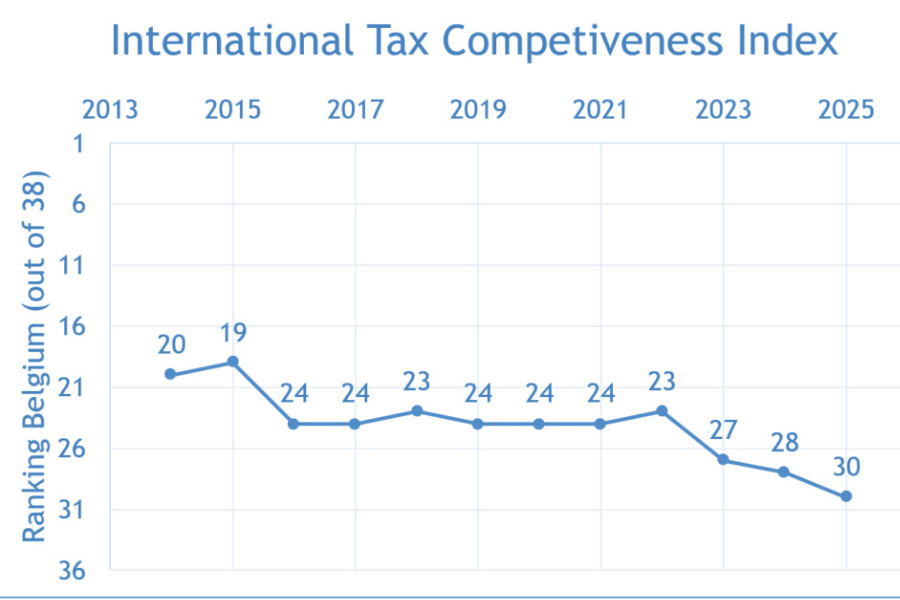
Source: VBO FEB, International Tax Competitiveness Index 2025 ranking (Belgium’s position and component scores).
Source: VBO FEB, International Tax Competitiveness Index 2025 ranking (Belgium’s position and component scores).
The chart shows Belgium ranking 30th out of 38 OECD countries in the 2025 International Tax Competitiveness Index, placing it among the weakest performers. The visual comparison highlights that Belgium lags particularly in consumption taxes, capital taxation, and cross-border tax rules, while corporate taxation is only around the OECD average. Another clearly implied weakness is the large gap between gross and net wages, which reduces labor market attractiveness. Overall, the graph illustrates that Belgium’s low position is driven less by extreme tax rates and more by the structure of its tax system and the slow pace of reform. While other countries have improved their frameworks, Belgium has remained largely static, causing its relative position to deteriorate over time.