Austria’s Inflation Remains Stable at 2.2% in February 2026
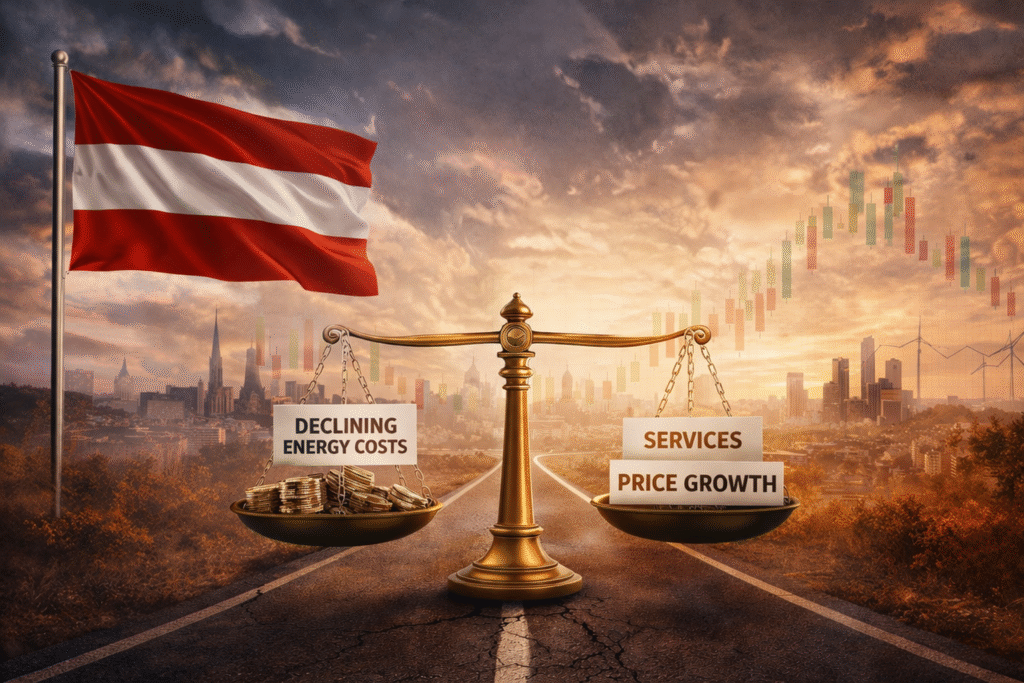
Flash Estimate Shows Moderate Price Growth as Services Offset Declining Energy Costs
Austria’s Inflation Remains Stable at 2.2% in February 2026
Flash Estimate Shows Moderate Price Growth as Services Offset Declining Energy Costs
PUBLISHED March 27, 2026
Stable Inflation According to Flash Estimate
According to a flash estimate published by Statistics Austria, the consumer price index (CPI) rose by 2.2% year-on-year in February 2026. This represents a slight increase compared to January, when inflation stood at 2.0%, indicating a modest uptick in overall price dynamics. The data suggests that inflation in Austria is currently stabilising at a moderate level rather than continuing its previous decline.
Monthly Price Developments Show Slight Increase
On a monthly basis, consumer prices increased compared to January, further confirming the upward movement in February. While the rise is relatively small, it highlights that price pressures are still present in the economy. The flash estimate provides an early indication of inflation trends, which may later be confirmed or slightly adjusted in the final data release.
Services as the Main Driver of Inflation
A key contributor to the overall inflation rate remains the increase in service prices. According to the estimate, services continue to exert upward pressure on the CPI, reflecting sustained demand and cost developments in this sector. This indicates that while inflation has eased overall, certain parts of the economy are still experiencing noticeable price growth.
Energy Prices Continue to Decline
In contrast, energy prices have continued to fall compared to the previous year, contributing to the containment of overall inflation. However, their impact is no longer as strong as in earlier periods, meaning they are less effective in offsetting increases in other categories. The role of energy in shaping inflation remains significant, even as its influence gradually diminishes.
Energy Prices Continue to Decline
In contrast, energy prices have continued to fall compared to the previous year, contributing to the containment of overall inflation. However, their impact is no longer as strong as in earlier periods, meaning they are less effective in offsetting increases in other categories. The role of energy in shaping inflation remains significant, even as its influence gradually diminishes.
Mixed Developments in Price Components
The flash estimate highlights differing trends across various components of the consumer price index. While some categories are showing clear increases, others are experiencing declines or stabilisation. This mixed development reflects a transitional phase in the Austrian economy, where inflationary pressures are unevenly distributed across sectors.
Implications for Economic Stability
The current inflation level, close to 2%, suggests a relatively balanced price environment. While inflation is no longer at elevated levels, the slight increase in February indicates that price stability has not yet been fully secured. For policymakers and analysts, the data points to a situation where inflation is under control but still requires monitoring.
Outlook Based on Preliminary Data
As the figures are based on a flash estimate, they provide an early snapshot of price developments rather than a final assessment. Nevertheless, the data indicates that Austria is moving toward a phase of moderate and stable inflation. Future releases will confirm whether this trend continues or if further fluctuations can be expected.
Mixed Developments in Price Components
The flash estimate highlights differing trends across various components of the consumer price index. While some categories are showing clear increases, others are experiencing declines or stabilisation. This mixed development reflects a transitional phase in the Austrian economy, where inflationary pressures are unevenly distributed across sectors.
Implications for Economic Stability
The current inflation level, close to 2%, suggests a relatively balanced price environment. While inflation is no longer at elevated levels, the slight increase in February indicates that price stability has not yet been fully secured. For policymakers and analysts, the data points to a situation where inflation is under control but still requires monitoring.
Outlook Based on Preliminary Data
As the figures are based on a flash estimate, they provide an early snapshot of price developments rather than a final assessment. Nevertheless, the data indicates that Austria is moving toward a phase of moderate and stable inflation. Future releases will confirm whether this trend continues or if further fluctuations can be expected.
Follow us on LinkedIn!
Follow us on LinkedIn!
Would you like to sell your products or services worldwide?
Schedule an appointment with our international sales team
Would you like to sell your products or services worldwide?
Schedule an appointment with our international sales team