

PUBLISHED February 28, 2026
According to the overview of the Dutch economy published by Raisin, the Netherlands is entering 2026 on a path of moderate but stable growth after several years marked by pandemic shocks, high inflation and geopolitical uncertainty.
The Dutch central bank (DNB) expects the economy to expand by around 1.2% in 2026, followed by 1.1% in 2027, signalling a return to steady but unspectacular growth. The outlook suggests that the Dutch economy is stabilising rather than accelerating.
From Strong Rebound to Normalisation
The Raisin analysis highlights how volatile the recent economic cycle has been. After the sharp pandemic contraction in 2020, the Netherlands experienced a powerful rebound in 2021 and 2022. Growth then slowed significantly, reaching just 0.1% in 2023 and 1.0% in 2024, before improving again in 2025.
For 2025, GDP growth is estimated at 1.7%, supported by higher wages that allow consumers to spend more and by increased government expenditure. However, the forecast clearly indicates that the economy is now moving into a more mature phase of the cycle.
Inflation Gradually Cooling
Price pressures, which surged earlier in the decade, are expected to continue easing. According to DNB projections cited by Raisin, inflation is forecast to decline from 3.0% in 2025 to about 2.4% in 2026, and further to 2.3% in 2027.
This disinflation trend should help restore household purchasing power and improve financial planning certainty for businesses. Even so, the report notes that inflation in the Netherlands has recently remained somewhat above the euro-area average, underscoring that the adjustment process is still ongoing.
While the macro outlook is broadly positive, short-term indicators paint a more nuanced picture. Recent data show that consumer confidence remains weak, with the index still well below its long-term average.
At the same time, producer sentiment has improved and turned positive for the first time in nearly three years, suggesting that the business sector is somewhat more optimistic than households. This divergence points to a recovery that is still uneven across the economy.
While the macro outlook is broadly positive, short-term indicators paint a more nuanced picture. Recent data show that consumer confidence remains weak, with the index still well below its long-term average.
At the same time, producer sentiment has improved and turned positive for the first time in nearly three years, suggesting that the business sector is somewhat more optimistic than households. This divergence points to a recovery that is still uneven across the economy.
The Raisin overview indicates that recent economic growth has been supported mainly by exports and public consumption. For example, the Dutch economy expanded 0.5% quarter-on-quarter in late 2025, with export performance playing a key role.
Household consumption, by contrast, has been more subdued at times, highlighting the continued sensitivity of the domestic demand side. Investment activity has also shown volatility, with declines in some categories such as buildings and transport equipment.
Despite cyclical softness, the Netherlands continues to rank among high-income economies with a relatively strong standard of living. Raisin notes that GDP per capita remains high by international comparison, reflecting the country’s productive and open economic structure.
However, the report also acknowledges that the economy has faced multiple headwinds in recent years, including the war in Ukraine, housing shortages and earlier inflation shocks. These factors help explain why the current outlook is one of cautious rather than rapid expansion.
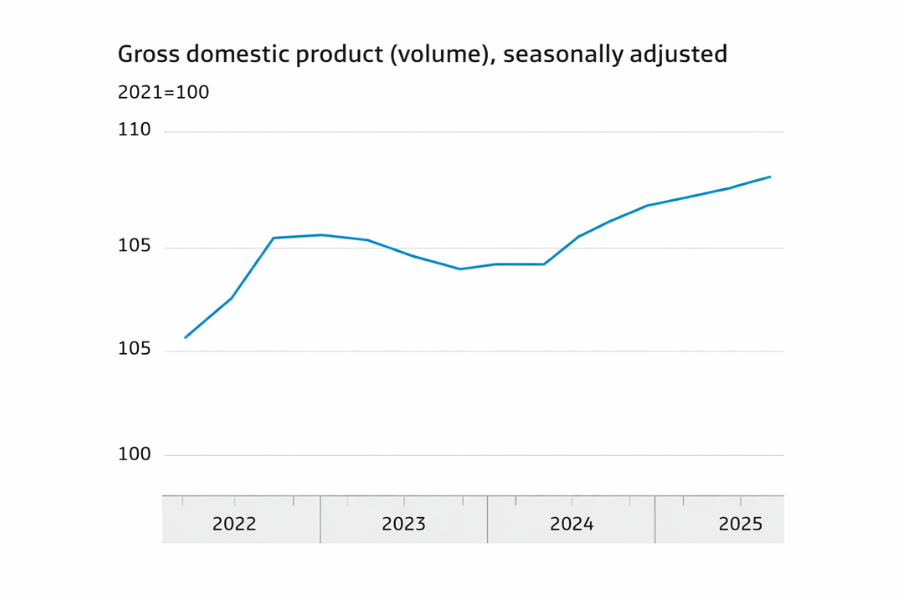
Looking ahead, the Dutch economy appears set for a period of moderate, stable growth. The combination of easing inflation, resilient exports and supportive government spending provides a solid foundation, but weak consumer confidence and lingering uncertainties continue to cap the upside.
For businesses and investors, the message is clear: the Netherlands is not heading into recession, but neither is it entering a high-growth phase.
Bottom line: The Dutch economy is stabilising in 2026 with growth expected around 1.2%. Inflation is cooling and fundamentals remain strong, but the recovery is uneven — pointing to steady progress rather than a rapid upswing.
The Raisin overview indicates that recent economic growth has been supported mainly by exports and public consumption. For example, the Dutch economy expanded 0.5% quarter-on-quarter in late 2025, with export performance playing a key role.
Household consumption, by contrast, has been more subdued at times, highlighting the continued sensitivity of the domestic demand side. Investment activity has also shown volatility, with declines in some categories such as buildings and transport equipment.
Despite cyclical softness, the Netherlands continues to rank among high-income economies with a relatively strong standard of living. Raisin notes that GDP per capita remains high by international comparison, reflecting the country’s productive and open economic structure.
However, the report also acknowledges that the economy has faced multiple headwinds in recent years, including the war in Ukraine, housing shortages and earlier inflation shocks. These factors help explain why the current outlook is one of cautious rather than rapid expansion.
Looking ahead, the Dutch economy appears set for a period of moderate, stable growth. The combination of easing inflation, resilient exports and supportive government spending provides a solid foundation, but weak consumer confidence and lingering uncertainties continue to cap the upside.
For businesses and investors, the message is clear: the Netherlands is not heading into recession, but neither is it entering a high-growth phase.
Bottom line: The Dutch economy is stabilising in 2026 with growth expected around 1.2%. Inflation is cooling and fundamentals remain strong, but the recovery is uneven — pointing to steady progress rather than a rapid upswing.

Reform PRODUCTS & SERVICES Group
Szentendrei út 87.
1033 Budapest
Hungary