

PUBLISHED February 28, 2026
According to the Bank of Japan’s “Outlook for Economic Activity and Prices” (January 2026), Japan’s economy is expected to continue expanding at a moderate pace as the long-anticipated wage-price cycle gradually strengthens. The central bank’s baseline scenario points to steady growth supported by improving overseas conditions, resilient corporate activity and accommodative financial conditions, although several external risks remain in view.
Growth Expected to Exceed Potential Temporarily
The Bank of Japan assesses that the economy has been recovering moderately and is likely to maintain this trajectory in the coming fiscal years. Overseas economies are expected to continue growing on the whole, providing a supportive external environment for Japanese exports and production. At the same time, the effects of past monetary easing and government economic measures are projected to continue underpinning domestic activity.
In fiscal 2026, growth is expected to clearly exceed Japan’s potential growth rate before gradually converging back toward trend in fiscal 2027 as policy support effects diminish. This pattern suggests a cyclical upswing rather than the start of a high-growth phase.
Corporate Sector Remains a Key Pillar
The corporate sector continues to provide important support to the outlook. The report notes that corporate profits have stayed at high levels overall, even though some manufacturing segments continue to face headwinds related to global trade developments.
Business fixed investment is projected to maintain an increasing trend, driven by firms’ efforts to address labor shortages, advance digitalisation and strengthen research and development capabilities.
These investment patterns reflect deeper structural pressures in Japan’s economy, particularly demographic constraints and the ongoing need to lift productivity.
Labour Market Tightness to Persist
Labour market conditions are expected to tighten further as the recovery progresses. The Bank anticipates that firms will maintain relatively strong wage increases following the significant pay hikes seen in the previous spring wage negotiations.
Nominal employee income is therefore projected to continue rising, reinforcing the gradual improvement in the income-spending cycle that policymakers have been seeking for years. The strengthening of this cycle remains central to the Bank’s medium-term outlook.
Despite improving wages, the near-term outlook for private consumption remains cautious. The report indicates that consumption is likely to remain more or less flat for the time being, mainly because past price increases have continued to weigh on household purchasing power.
Over time, however, consumption is expected to return to a moderate growth path as income gains become more firmly established and the drag from earlier inflation fades. Housing investment is projected to show a temporary recovery but is likely to trend modestly downward thereafter, reflecting higher housing prices and demographic factors.
Despite improving wages, the near-term outlook for private consumption remains cautious. The report indicates that consumption is likely to remain more or less flat for the time being, mainly because past price increases have continued to weigh on household purchasing power.
Over time, however, consumption is expected to return to a moderate growth path as income gains become more firmly established and the drag from earlier inflation fades. Housing investment is projected to show a temporary recovery but is likely to trend modestly downward thereafter, reflecting higher housing prices and demographic factors.
On the price front, the Bank of Japan expects the year-on-year rate of increase in the consumer price index excluding fresh food to fall below 2 percent in the first half of fiscal 2026. This temporary slowdown largely reflects the waning impact of earlier rises in import and food prices as well as the effects of government measures aimed at easing the burden on households.
However, the Bank emphasises that the underlying inflation mechanism is strengthening. As the economy continues to improve and labor shortages persist, firms are expected to gradually pass higher wage costs through to selling prices. Over the medium term, this process is projected to keep inflation at a level generally consistent with the Bank’s 2 percent price stability target.
The policy outlook reflects this cautiously constructive assessment. If economic activity and prices evolve broadly in line with projections, the Bank of Japan indicates it will continue to adjust the degree of monetary accommodation, including further policy rate increases as appropriate.
At the same time, the report stresses that uncertainties remain high. Particular attention is being paid to global economic developments, firms’ wage- and price-setting behaviour and movements in financial and foreign-exchange markets, all of which could influence the timing and pace of policy normalisation.
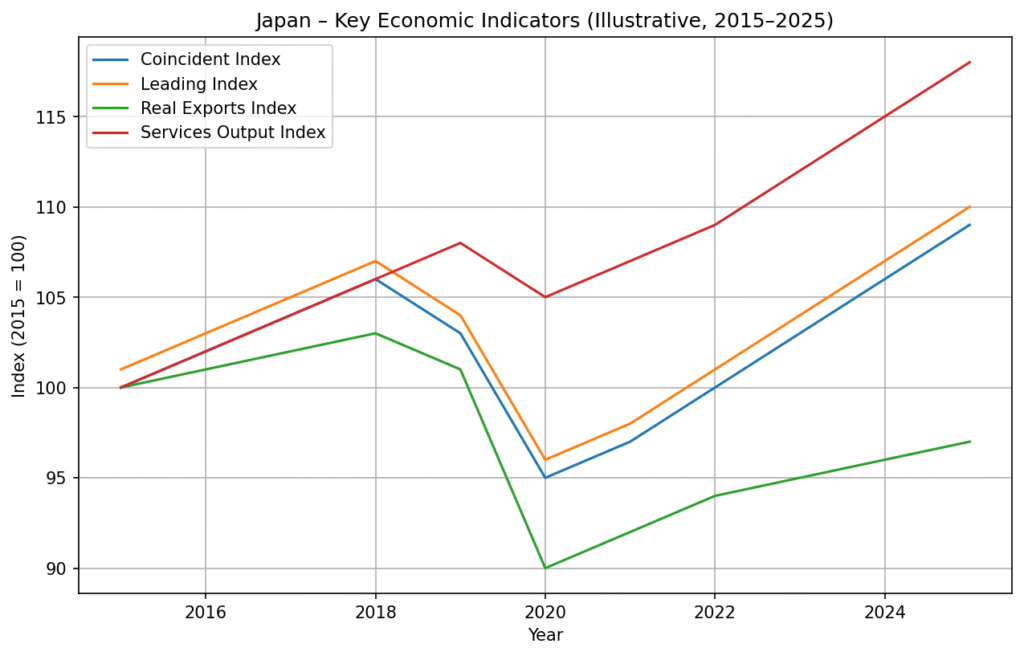
Taken together, the January outlook portrays an economy that is gradually gaining internal momentum but still requires careful monitoring. The long-sought virtuous cycle between wages and prices appears to be taking firmer hold, yet the recovery in consumption remains measured and the inflation path is expected to fluctuate around target before stabilising.
Bottom line: The Bank of Japan expects moderate economic expansion to continue through 2026, supported by rising wages and solid corporate investment. Inflation may dip below 2 percent in the near term but is projected to stabilise around target as the wage-price cycle strengthens, allowing for cautious and gradual monetary policy normalisation.
On the price front, the Bank of Japan expects the year-on-year rate of increase in the consumer price index excluding fresh food to fall below 2 percent in the first half of fiscal 2026. This temporary slowdown largely reflects the waning impact of earlier rises in import and food prices as well as the effects of government measures aimed at easing the burden on households.
However, the Bank emphasises that the underlying inflation mechanism is strengthening. As the economy continues to improve and labor shortages persist, firms are expected to gradually pass higher wage costs through to selling prices. Over the medium term, this process is projected to keep inflation at a level generally consistent with the Bank’s 2 percent price stability target.
The policy outlook reflects this cautiously constructive assessment. If economic activity and prices evolve broadly in line with projections, the Bank of Japan indicates it will continue to adjust the degree of monetary accommodation, including further policy rate increases as appropriate.
At the same time, the report stresses that uncertainties remain high. Particular attention is being paid to global economic developments, firms’ wage- and price-setting behaviour and movements in financial and foreign-exchange markets, all of which could influence the timing and pace of policy normalisation.
Taken together, the January outlook portrays an economy that is gradually gaining internal momentum but still requires careful monitoring. The long-sought virtuous cycle between wages and prices appears to be taking firmer hold, yet the recovery in consumption remains measured and the inflation path is expected to fluctuate around target before stabilising.
Bottom line: The Bank of Japan expects moderate economic expansion to continue through 2026, supported by rising wages and solid corporate investment. Inflation may dip below 2 percent in the near term but is projected to stabilise around target as the wage-price cycle strengthens, allowing for cautious and gradual monetary policy normalisation.

Reform PRODUCTS & SERVICES Group
Szentendrei út 87.
1033 Budapest
Hungary