

PUBLISHED January 21, 2026
According to “The 2025 US economy – in charts: rising prices, hiring slowdown, rollercoaster growth” from The Guardian, published 28 Dec 2025, the 2025 US economic performance presents a complex picture that defies simple characterisation. According to official statistics analysed by The Guardian, headline numbers such as GDP growth have offered some positive signals at times during the year, suggesting resilience in the world’s largest economy. However, other indicators suggest underlying fragility rather than sustained boom conditions. Throughout the year, policymakers, economists, and the public have wrestled with these contrasting signals. Tensions between presidential rhetoric and official data have sharpened debate about the true health of the economy. While economic growth in parts of the year outpaced expectations, that resilience was not uniform across all key metrics. Understanding the broader pattern requires looking beyond quarterly GDP figures to trends in prices, interest rates, and employment. The mixed data raise questions about how broadly Americans are feeling the reported gains.
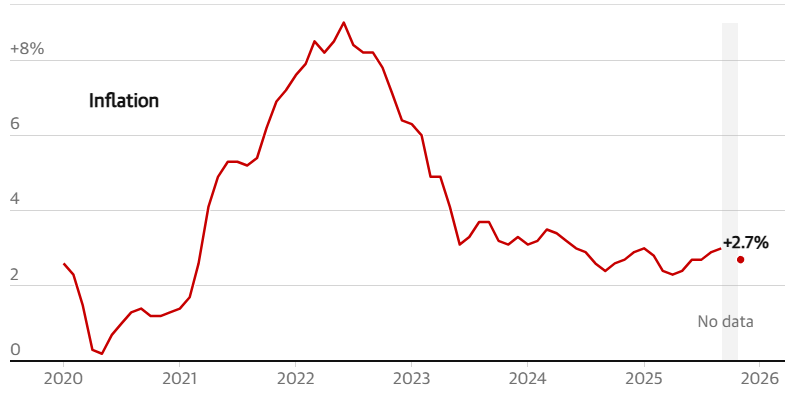
Inflation has remained a central concern in 2025. After peaking at multi-decade highs in the early post-pandemic period, price growth proved stubborn, holding at elevated levels through much of the year despite efforts by the Federal Reserve to cool the economy. Consumer prices did not fall as sharply as many had hoped, and tariff-related policies added complexity to price dynamics, with some sectors facing upward pressure on costs. Meanwhile, interest rate policy became a contentious issue, with ongoing debate between executive branch priorities and central bank caution. The Federal Reserve gradually trimmed rates from their historical peaks, but policymakers emphasised careful calibration to avoid derailing inflation progress. Internal policy disagreements and public criticism of central bank leadership became part of the economic narrative. This environment shaped both business planning and consumer expectations as 2025 unfolded.
The labour market also reflected contrasting forces in 2025. Earlier in the decade, job growth had been a central pillar of the US economic rebound, driven by post-pandemic expansion across multiple sectors. But during the year, that momentum slowed noticeably. Reports showed periods of outright job losses during certain months, and employment gains were far weaker than in previous years. A prolonged federal government shutdown in October contributed to temporary job reductions, while the civilian workforce saw overall employment lag. These shifts pushed the unemployment rate upward to its highest point in several years by late 2025, challenging claims of an all-out labour surge. Even as some sectors continued to add jobs, the general trend pointed to a moderation in the labour market’s dynamism.
In 2025, the US economy experienced striking swings in output, as shown in official growth statistics. After a contraction in the first quarter of the year — partly triggered by pre-tariff imports and weak domestic demand — the economy rebounded in the second and posted strong growth in the third quarter. Gross domestic product expanded at an above-expected rate of 4.3 % in Q3, far outpacing many economists’ projections. This surge contributed to an overall annual growth estimate of around 2 % for the year, a respectable pace in global terms and one that suggests resilience in certain sectors. Yet beneath this headline strength, the pattern was uneven. Growth was not consistent year-round, and the economy’s capacity to sustain high performance was called into question by softer readings in other quarters and by underlying weakness in areas such as investment and consumer confidence. Such variability illustrates why simple yearly averages do not fully capture the complex dynamics of the US economy in 2025.
In 2025, the US economy experienced striking swings in output, as shown in official growth statistics. After a contraction in the first quarter of the year — partly triggered by pre-tariff imports and weak domestic demand — the economy rebounded in the second and posted strong growth in the third quarter. Gross domestic product expanded at an above-expected rate of 4.3 % in Q3, far outpacing many economists’ projections. This surge contributed to an overall annual growth estimate of around 2 % for the year, a respectable pace in global terms and one that suggests resilience in certain sectors. Yet beneath this headline strength, the pattern was uneven. Growth was not consistent year-round, and the economy’s capacity to sustain high performance was called into question by softer readings in other quarters and by underlying weakness in areas such as investment and consumer confidence. Such variability illustrates why simple yearly averages do not fully capture the complex dynamics of the US economy in 2025.
Despite early efforts to rein in consumer price increases, inflation remained a central challenge throughout 2025. Price growth did cool from its peak levels, but it did not fall to the low levels many analysts had hoped for. Persistent price pressures were attributed in part to tariffs on imported goods, which kept costs elevated in key consumer categories. The Federal Reserve responded with a series of interest rate adjustments, attempting to strike a balance between taming inflation and supporting economic activity. By year-end, the central bank had begun cutting rates from their highest levels in decades, but it did so with caution, wary of undoing progress toward price stability. Disagreement between elected officials advocating rapid rate reductions and central bank leaders favouring a more gradual path became a notable theme in public discourse. These policy tensions underscored the challenge of managing inflation expectations while avoiding excessive tightening that could choke off growth prematurely.
Employment trends in 2025 painted a more nuanced picture than broad claims of a booming job market. After strong job creation in previous years, the pace of hiring decelerated, with some months showing net job losses rather than gains. A historic government shutdown in October contributed to downward pressure, with tens of thousands of positions cut temporarily. Meanwhile, job growth outside the public sector was modest, and some data suggested that more Americans were entering the job market than new jobs were being created. As a result, the unemployment rate trended upward through the year, reaching its highest level since late 2021 by November. This increase contrasted sharply with repeated assertions from political leaders that unemployment was low and that jobs were plentiful. Although some sectors continued to add workers, the overall trend pointed to a softening of labour market momentum, prompting concerns about wage growth, job security, and long-term employment prospects for many workers.
Source: The Guardian, The 2025 US economy in charts (2025)
The first chart in the article illustrates how US economic output fluctuated throughout 2025. After a weak start with contraction in the first quarter, GDP rebounded sharply in the third quarter, growing at an annualized rate well above expectations. This pattern highlights a roller-coaster year: strong bursts of growth were offset by periods of sluggish activity, rather than steady expansion. The contrast suggests that headline figures alone can be misleading, because short-term gains in certain quarters may mask underlying weaknesses in investment, consumer confidence, and broader economic stability. In essence, the chart visualizes that while the US economy showed resilience in parts of 2025, it did not sustain balanced growth across all quarters.
Despite early efforts to rein in consumer price increases, inflation remained a central challenge throughout 2025. Price growth did cool from its peak levels, but it did not fall to the low levels many analysts had hoped for. Persistent price pressures were attributed in part to tariffs on imported goods, which kept costs elevated in key consumer categories. The Federal Reserve responded with a series of interest rate adjustments, attempting to strike a balance between taming inflation and supporting economic activity. By year-end, the central bank had begun cutting rates from their highest levels in decades, but it did so with caution, wary of undoing progress toward price stability. Disagreement between elected officials advocating rapid rate reductions and central bank leaders favouring a more gradual path became a notable theme in public discourse. These policy tensions underscored the challenge of managing inflation expectations while avoiding excessive tightening that could choke off growth prematurely.
Employment trends in 2025 painted a more nuanced picture than broad claims of a booming job market. After strong job creation in previous years, the pace of hiring decelerated, with some months showing net job losses rather than gains. A historic government shutdown in October contributed to downward pressure, with tens of thousands of positions cut temporarily. Meanwhile, job growth outside the public sector was modest, and some data suggested that more Americans were entering the job market than new jobs were being created. As a result, the unemployment rate trended upward through the year, reaching its highest level since late 2021 by November. This increase contrasted sharply with repeated assertions from political leaders that unemployment was low and that jobs were plentiful. Although some sectors continued to add workers, the overall trend pointed to a softening of labour market momentum, prompting concerns about wage growth, job security, and long-term employment prospects for many workers.
Source: The Guardian, The 2025 US economy in charts (2025)
The first chart in the article illustrates how US economic output fluctuated throughout 2025. After a weak start with contraction in the first quarter, GDP rebounded sharply in the third quarter, growing at an annualized rate well above expectations. This pattern highlights a roller-coaster year: strong bursts of growth were offset by periods of sluggish activity, rather than steady expansion. The contrast suggests that headline figures alone can be misleading, because short-term gains in certain quarters may mask underlying weaknesses in investment, consumer confidence, and broader economic stability. In essence, the chart visualizes that while the US economy showed resilience in parts of 2025, it did not sustain balanced growth across all quarters.

Reform PRODUCTS & SERVICES Group
Szentendrei út 87.
1033 Budapest
Hungary