

PUBLISHED January 21, 2026
According to IFM Investors’ December 2025 Economic Update, as 2025 drew to a close, global markets settled into unexpectedly firmer footing after months of volatility and shifting economic conditions. Equity markets, particularly in the United States and parts of Europe, rebounded strongly from earlier losses tied to tariff shocks and policy turbulence. Investors saw gains despite ongoing geopolitical tensions and uncertainty about central bank direction. Trade tensions have eased somewhat, but the risk of renewed policy volatility remains high heading into 2026. Advanced economies overall are expected to experience only modest expansion, with economic forecasts hinging on a delicate balance of fiscal and monetary policy. Market participants observed resilience in several key sectors even as broader sentiment fluctuated. Looking ahead, analysts warn that last year’s relative calm may give way to new sources of uncertainty in the months ahead.
Equity markets showed notable strength by year’s end, with U.S. benchmarks and European indices posting solid returns overall, though gains have been concentrated in a few sectors. Fixed income markets signalled a turning point mid-year as long-duration government bonds rallied amidst choppy conditions, despite spreads remaining tight. Yield curves steepened in many advanced economies, reflecting a combination of fiscal slack and investor reassessment of long-term risk premiums. Loose fiscal stances and large deficits are expected to continue into 2026, making it harder for governments to tighten policy without stoking discontent. Defence spending pressures and geopolitical risks, including ongoing conflicts, add complexity to fiscal planning. As a result, investors remain cautious about future policy shifts.
Equity markets in 2025 ended on a strong note after a turbulent year, but gains were not uniform across sectors or regions. In the U.S., equity price returns were driven significantly by a few high-performing industries, including technology and AI-related firms, while broader indices lagged behind in fundamental strength. Markets swung from notable lows to meaningful highs as investor sentiment oscillated on news about tariff policies, political uncertainties, and corporate earnings. European markets, particularly in smaller economies, also saw solid returns, though overall performance varied by country and sector. Australian markets posted modest gains in comparison. While these rebounds suggest resilience, analysts caution that sustained equity performance will require earnings growth outside narrow sector drivers. Without broader participation, market advances may prove fragile.
Equity markets in 2025 ended on a strong note after a turbulent year, but gains were not uniform across sectors or regions. In the U.S., equity price returns were driven significantly by a few high-performing industries, including technology and AI-related firms, while broader indices lagged behind in fundamental strength. Markets swung from notable lows to meaningful highs as investor sentiment oscillated on news about tariff policies, political uncertainties, and corporate earnings. European markets, particularly in smaller economies, also saw solid returns, though overall performance varied by country and sector. Australian markets posted modest gains in comparison. While these rebounds suggest resilience, analysts caution that sustained equity performance will require earnings growth outside narrow sector drivers. Without broader participation, market advances may prove fragile.
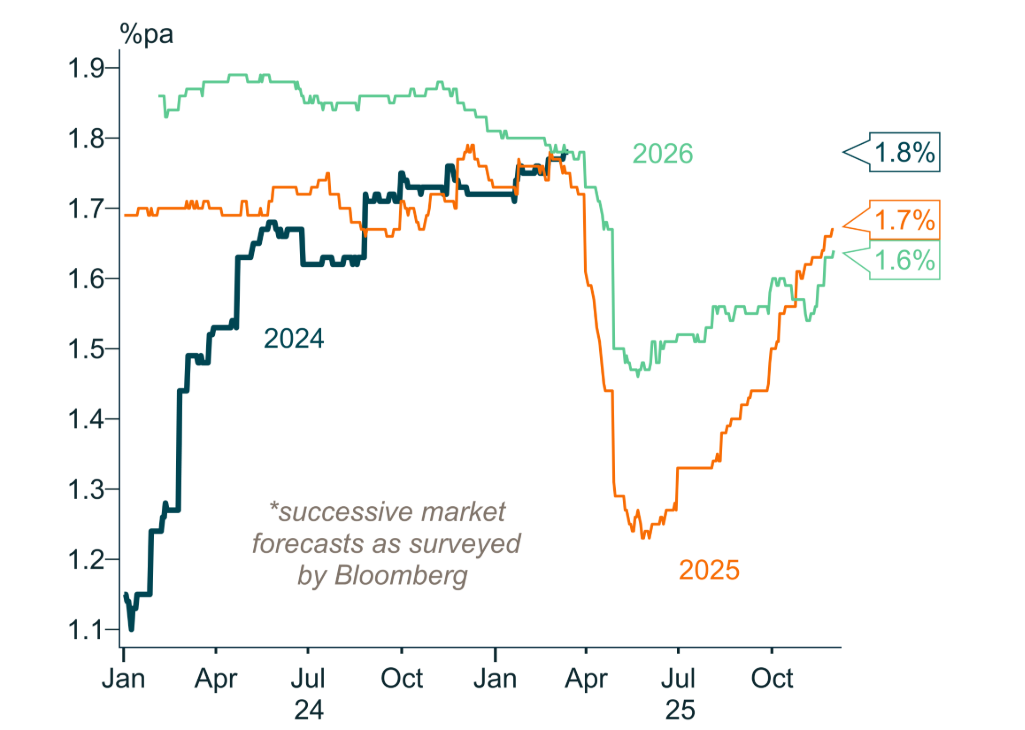
Source: IFM Investors, Economic Update – December 2025
The chart highlights how global equity markets ended 2025 with positive overall returns, but with strong regional and sectoral differences. US markets outperformed most others, driven largely by a narrow group of technology-focused companies, while gains in Europe and other regions were more moderate. This uneven pattern suggests that investor confidence was selective rather than broad-based. Although headline indices improved, the chart indicates that market strength relied on limited drivers, making the recovery more fragile than it appears at first glance.
Fixed income markets experienced a mid-year rally, particularly among long-duration government bonds, as investors sought yield amid uncertain growth prospects. Despite this, long bonds underperformed compared with shorter maturities overall, and broader fixed income instruments are expected to provide limited outperformance in 2026. Yield curves in many G7 countries steepened, with 30-year bond yields reaching levels not seen in over a decade as investors demanded greater compensation for risk. Tight credit spreads and rising long-term yields reflect skepticism about fiscal discipline and the persistence of loose monetary policy. Looking ahead, with fiscal accommodation likely to continue, the potential for further steepening exists, though core fixed income returns are unlikely to diverge sharply from modest forecasts.
In the context of modest growth and persistent volatility, real assets — especially unlisted infrastructure — are emerging as attractive options for investors. Infrastructure investments tend to provide stable returns and serve as defensive positions when equity and fixed income markets lack clear upside. Given the likelihood of continued geopolitical tension and fiscal pressure, real assets may offer a degree of resilience against market swings. These assets benefit not only from long-term contractual cash flows but also from increased government and private spending in sectors such as energy transition, transportation, and essential services. While no asset class is immune to market risk, unlisted infrastructure is increasingly seen as a strategic hedge in portfolios seeking diversification and steady performance amid economic uncertainty.
Source: IFM Investors, Economic Update – December 2025
The chart highlights how global equity markets ended 2025 with positive overall returns, but with strong regional and sectoral differences. US markets outperformed most others, driven largely by a narrow group of technology-focused companies, while gains in Europe and other regions were more moderate. This uneven pattern suggests that investor confidence was selective rather than broad-based. Although headline indices improved, the chart indicates that market strength relied on limited drivers, making the recovery more fragile than it appears at first glance.

Reform PRODUCTS & SERVICES Group
Szentendrei út 87.
1033 Budapest
Hungary