

PUBLISHED January 13, 2026
According to “Die wirtschaftliche Lage in Deutschland im Dezember 2025” from the Bundesministerium für Wirtschaft und Klimaschutz (BMWK) press release, as Germany approaches the end of 2025, its economy finds itself caught in a delicate balance between external headwinds and gradual domestic stabilisation. Recent data suggest that the fourth quarter began on a relatively solid footing, particularly in the industrial sector, where production increased again and domestic orders rose noticeably in October. At the same time, exports benefited from stronger demand within the European Union, reaching a six-month high. Yet beneath these encouraging signals lies a more complex picture shaped by weakened business expectations, muted consumer confidence, and persistent global uncertainties.
Industrial production emerged as one of the brighter toward the end of the year. Output in the manufacturing sector rose by 1.8 percent month on month in October after seasonal and calendar adjustment, marking the second consecutive increase. On a year-on-year basis, production was up 0.8 percent, suggesting that the sharp downturn feared earlier in the year has not materialised. Investment goods production, in particular, provided momentum, supported by stronger domestic demand and a significant defence-related order. Construction activity and energy generation also recorded noticeable gains, reinforcing the impression of a broad-based, if still fragile, stabilisation.
Despite this progress, the broader trend remains subdued. Over a three-month comparison, industrial output continued to contract, underscoring that the recovery has yet to gain lasting traction. Foreign demand remains a weak point, with orders from non-euro area countries declining again in October. Supply bottlenecks for certain intermediate goods and the lingering effects of geopolitical tensions continue to weigh on Germany’s export-oriented industries. Early indicators suggest stabilisation rather than a decisive upswing, a message echoed by business surveys across key sectors.
Retail sales excluding motor vehicles declined slightly in October, driven mainly by weaker demand for non-food items, while food retail posted moderate growth. New passenger car registrations by private households increased markedly in November, both month on month and over a three-month horizon, offering some support to consumption-related industries. Nevertheless, sentiment indicators paint a cautious picture ahead of the crucial Christmas season. Surveys reveal that households remain concerned about price developmentssensitivity, future income prospects, and job security, dampening spending enthusiasm despite some improvement in purchasing intentions.
Retail sales excluding motor vehicles declined slightly in October, driven mainly by weaker demand for non-food items, while food retail posted moderate growth. New passenger car registrations by private households increased markedly in November, both month on month and over a three-month horizon, offering some support to consumption-related industries. Nevertheless, sentiment indicators paint a cautious picture ahead of the crucial Christmas season. Surveys reveal that households remain concerned about price developmentssensitivity, future income prospects, and job security, dampening spending enthusiasm despite some improvement in purchasing intentions.
Seasonally adjusted unemployment remained almost unchanged in November, while employment levels edged down only marginally. Social security-covered employment increased slightly earlier in the autumn, broadly matching last year’s levels. However, forward-looking indicators point to limited momentum in labour demand. The rise in short-time work after the summer holidays and the decline in employment expectations across manufacturing and services highlight employers’ continued caution. Overall, Germany’s economic performance at the close of 2025 reflects resilience without dynamism. Domestic stabilisation, supported by fiscal impulses and recovering investment demand, contrasts with a challenging international environment marked by weak external orders and geopolitical risks. As the year ends, the data suggest that the economy has avoided a deeper downturn, but a sustained recovery remains elusive, leaving policymakers and businesses alike navigating an environment defined by uncertainty rather than confidence.
Inflation developments have become more predictable but remain a key factor shaping economic behaviour. The inflation rate held steady at 2.3 percent in November, aligning closely with expectations. Price pressures have increasingly shifted from goods to services, with service prices rising by 3.5 percent and emerging as the dominant driver of inflation. In contrast, goods prices rose only modestly, and energy prices continued to exert a dampening effect, albeit less pronounced than during the summer. Looking ahead, consumer prices are expected to remain slightly above two percent, with wage-driven service inflation continuing to play a central role.
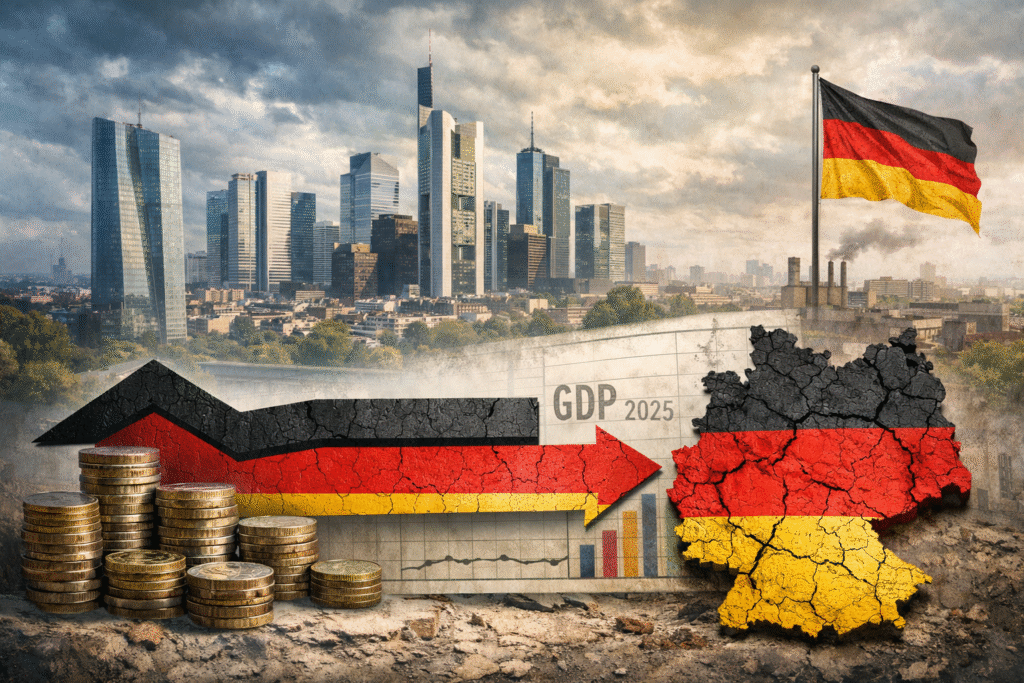
Domestic stabilisation, supported by fiscal impulses and recovering investment demand, contrasts with a challenging international environment marked by weak external orders and geopolitical risks. As the year ends, the data suggest that the economy has avoided a deeper downturn, but a sustained recovery remains elusive, leaving policymakers and businesses alike navigating an environment defined by uncertainty rather than confidence.
Seasonally adjusted unemployment remained almost unchanged in November, while employment levels edged down only marginally. Social security-covered employment increased slightly earlier in the autumn, broadly matching last year’s levels. However, forward-looking indicators point to limited momentum in labour demand. The rise in short-time work after the summer holidays and the decline in employment expectations across manufacturing and services highlight employers’ continued caution. Overall, Germany’s economic performance at the close of 2025 reflects resilience without dynamism. Domestic stabilisation, supported by fiscal impulses and recovering investment demand, contrasts with a challenging international environment marked by weak external orders and geopolitical risks. As the year ends, the data suggest that the economy has avoided a deeper downturn, but a sustained recovery remains elusive, leaving policymakers and businesses alike navigating an environment defined by uncertainty rather than confidence.
Inflation developments have become more predictable but remain a key factor shaping economic behaviour. The inflation rate held steady at 2.3 percent in November, aligning closely with expectations. Price pressures have increasingly shifted from goods to services, with service prices rising by 3.5 percent and emerging as the dominant driver of inflation. In contrast, goods prices rose only modestly, and energy prices continued to exert a dampening effect, albeit less pronounced than during the summer. Looking ahead, consumer prices are expected to remain slightly above two percent, with wage-driven service inflation continuing to play a central role.
Domestic stabilisation, supported by fiscal impulses and recovering investment demand, contrasts with a challenging international environment marked by weak external orders and geopolitical risks. As the year ends, the data suggest that the economy has avoided a deeper downturn, but a sustained recovery remains elusive, leaving policymakers and businesses alike navigating an environment defined by uncertainty rather than confidence.
Reform PRODUCTS & SERVICES Group
Szentendrei út 87.
1033 Budapest
Hungary