
PUBLISHED January 20, 2026
According to “Aperçu de l’activité économique en Belgique” published on Economie.fgov.be by the Service public fédéral Économie, Belgium, a small open economy of nearly 11.8 million people, recorded GDP growth of 1.1 % in 2024, slowing from 1.7 % the previous year. This moderate expansion reflects sustained domestic demand and private consumption, with net exports contributing little in early 2025. Belgium’s economic position remains reliant on internal demand and the services sector as key growth drivers.
Belgium’s overall economic expansion remains moderate. GDP grew by 1.1 % in 2024, reflecting slower momentum than in prior years. By the second quarter of 2025, annual GDP growth reached about 1 %, supported equally by changes in inventories and domestic demand excluding stock, a sign that consumer spending continues to fuel output. Private consumption remains the most resilient component, contributing strongly to growth, whereas net exports had no net impact in the same period. Services consistently stand as Belgium’s central growth engine, contributing the largest share to GDP increases, with construction providing a smaller but still positive contribution.
Belgium’s overall economic expansion remains moderate. GDP grew by 1.1 % in 2024, reflecting slower momentum than in prior years. By the second quarter of 2025, annual GDP growth reached about 1 %, supported equally by changes in inventories and domestic demand excluding stock, a sign that consumer spending continues to fuel output. Private consumption remains the most resilient component, contributing strongly to growth, whereas net exports had no net impact in the same period. Services consistently stand as Belgium’s central growth engine, contributing the largest share to GDP increases, with construction providing a smaller but still positive contribution.
Industrial production showed a steep decline in early 2025, with manufacturing output falling sharply compared with the previous year and reaching its lowest level since the pandemic period. This contraction reflects weaker external demand, higher production costs, and ongoing competitive pressure from non-EU producers. Several export-oriented industries, including chemicals and machinery, were particularly affected by slower global trade dynamics. In contrast, the energy sector recorded exceptionally strong growth. Output in electricity, gas, steam, and air-conditioning supply increased significantly, driven by infrastructure adjustments, changing energy consumption patterns, and greater reliance on domestic production capacity. This divergence underlines a structural shift within the Belgian economy, where traditional manufacturing is losing weight while strategic sectors such as energy and services gain importance. Construction activity also declined markedly in 2025, contributing negatively to overall industrial indicators. Rising financing costs and uncertainty in real estate markets have delayed investment decisions and new projects. Although services continue to act as the economy’s main stabilizing force, the imbalance between expanding and contracting sectors raises concerns about long-term industrial competitiveness and regional employment opportunities.
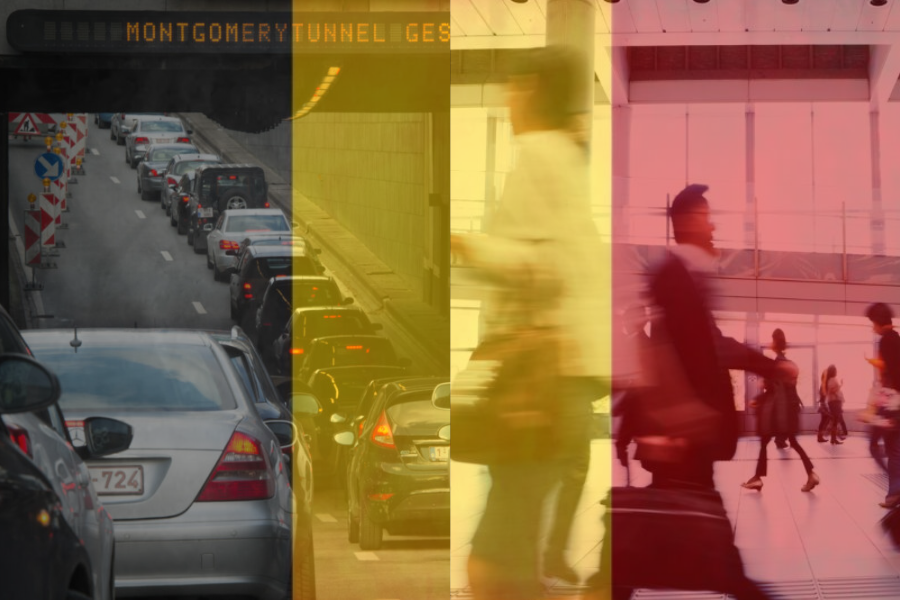
Belgium’s economy continues its modest expansion, underpinned by resilient private consumption and a strong services sector. However, sharp declines in manufacturing output and construction, together with mixed labor market signals and fragile business confidence, highlight persistent structural imbalances. Inflation is slowing, and the outlook points to continued moderate growth, but recent trends suggest that Belgium’s recovery remains uneven across sectors.
Industrial production showed a steep decline in early 2025, with manufacturing output falling sharply compared with the previous year and reaching its lowest level since the pandemic period. This contraction reflects weaker external demand, higher production costs, and ongoing competitive pressure from non-EU producers. Several export-oriented industries, including chemicals and machinery, were particularly affected by slower global trade dynamics. In contrast, the energy sector recorded exceptionally strong growth. Output in electricity, gas, steam, and air-conditioning supply increased significantly, driven by infrastructure adjustments, changing energy consumption patterns, and greater reliance on domestic production capacity. This divergence underlines a structural shift within the Belgian economy, where traditional manufacturing is losing weight while strategic sectors such as energy and services gain importance. Construction activity also declined markedly in 2025, contributing negatively to overall industrial indicators. Rising financing costs and uncertainty in real estate markets have delayed investment decisions and new projects. Although services continue to act as the economy’s main stabilizing force, the imbalance between expanding and contracting sectors raises concerns about long-term industrial competitiveness and regional employment opportunities.
Employment reached its highest level in over a decade, yet overall unemployment rose to roughly 6 % by mid‑2025, showing that job creation has only partially absorbed new labor market entrants. Youth unemployment improved slightly, indicating better integration of younger workers. Business confidence has rebounded from the lows of 2023 but remains cautious. While company formations still outnumber closures, the pace has slowed compared with last year, and bankruptcies continue to rise in sectors like construction and retail. Meanwhile, inflation has eased to around 2.9 %, aided by lower energy prices, which has helped stabilize both household purchasing power and business planning.
Belgium’s economy continues its modest expansion, underpinned by resilient private consumption and a strong services sector. However, sharp declines in manufacturing output and construction, together with mixed labor market signals and fragile business confidence, highlight persistent structural imbalances. Inflation is slowing, and the outlook points to continued moderate growth, but recent trends suggest that Belgium’s recovery remains uneven across sectors.