

PUBLISHED January 15, 2026
According to “Mehr als jede dritte Firmenpleite 2025 in Österreich aus Wien” from MeinBezirk.at, Vienna has long been considered the economic heart of Austria and one of the most attractive business locations in Central Europe. The city benefits from strong infrastructure, a highly skilled workforce, and a stable political and legal environment. For decades, it has drawn entrepreneurs, international companies, and investors looking for reliable growth and access to regional markets. Even in 2025, official economic indicators suggest that Vienna remains relatively resilient compared to other parts of the country. At first glance, this paints a picture of stability and confidence. Office buildings continue to rise, tourism remains strong, and new businesses are registered every month. However, these visible signs of vitality only tell part of the story.
The growing wave of bankruptcies highlights a widening gap between economic performance on paper and the reality faced by many businesses. Rising energy prices, cautious consumer spending, and tighter lending conditions have created an environment in which even well-established companies can quickly run into financial trouble. As insolvencies continue to rise, their effects reach far beyond the affected firms themselves. Employees lose jobs, suppliers face unpaid invoices, and entire business networks become more fragile. Vienna’s situation therefore serves as an important indicator of the challenges confronting Austria’s broader economy in 2025.
Beyond the sheer number of affected companies, the financial dimension of Vienna’s insolvency wave is equally alarming. Insolvent firms in the capital are expected to leave behind liabilities totaling more than €4.3 billion, which accounts for over half of Austria’s total corporate insolvency debt. This concentration of unpaid obligations represents a heavy burden for banks, suppliers, landlords, and public institutions. The impact is unevenly distributed across industries, but several sectors stand out. Retail businesses continue to be hit hardest, as online competition, shrinking consumer spending, and high operating costs erode already narrow profit margins. Construction companies face rising material prices and project delays, while real estate firms are affected by higher interest rates and declining investment activity. The hospitality sector, still recovering from pandemic-era losses, also remains vulnerable. This sectoral pattern reveals that the problem is not limited to one struggling niche of the economy. Instead, it reflects a broad-based weakening of business stability across traditional and modern industries alike. As companies accumulate debt to stay afloat, many eventually reach a point where restructuring is no longer possible.
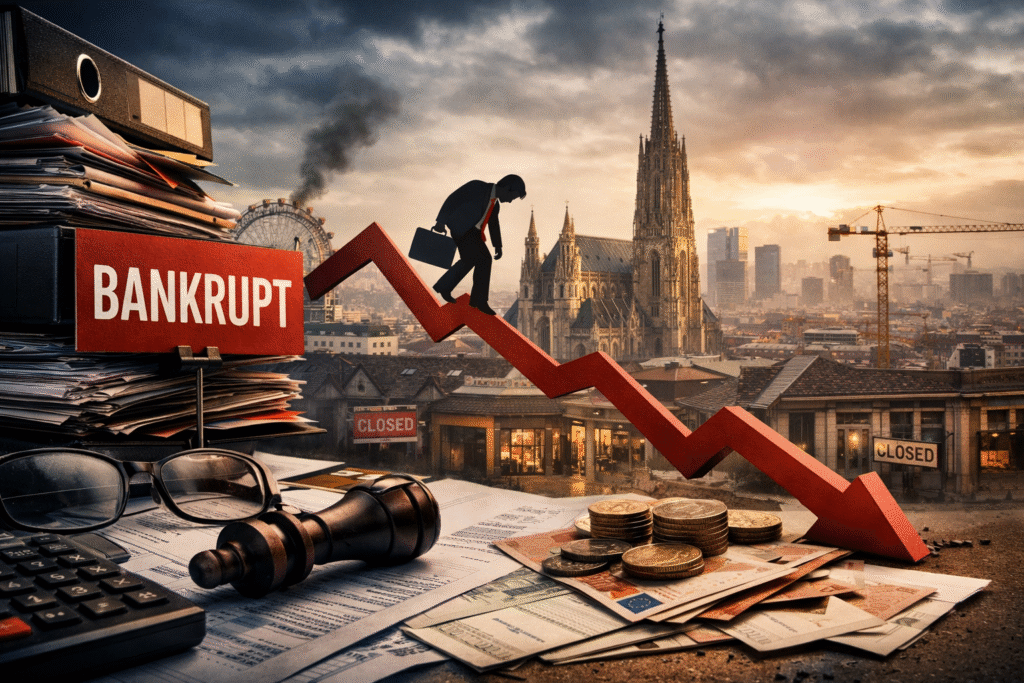
Beyond the sheer number of affected companies, the financial dimension of Vienna’s insolvency wave is equally alarming. Insolvent firms in the capital are expected to leave behind liabilities totaling more than €4.3 billion, which accounts for over half of Austria’s total corporate insolvency debt. This concentration of unpaid obligations represents a heavy burden for banks, suppliers, landlords, and public institutions. The impact is unevenly distributed across industries, but several sectors stand out. Retail businesses continue to be hit hardest, as online competition, shrinking consumer spending, and high operating costs erode already narrow profit margins. Construction companies face rising material prices and project delays, while real estate firms are affected by higher interest rates and declining investment activity. The hospitality sector, still recovering from pandemic-era losses, also remains vulnerable. This sectoral pattern reveals that the problem is not limited to one struggling niche of the economy. Instead, it reflects a broad-based weakening of business stability across traditional and modern industries alike. As companies accumulate debt to stay afloat, many eventually reach a point where restructuring is no longer possible.