Sweden’s Base Industry Exports Face New Headwinds in 2025
Germany weakens, U.S. tariffs hit steel, and global uncertainty reshapes Sweden’s industrial trade map
Sweden’s Base Industry Exports Face New Headwinds in 2025
Germany weakens, U.S. tariffs hit steel, and global uncertainty reshapes Sweden’s industrial trade map
PUBLISHED April 28, 2026
Export Powerhouse Remains Vital
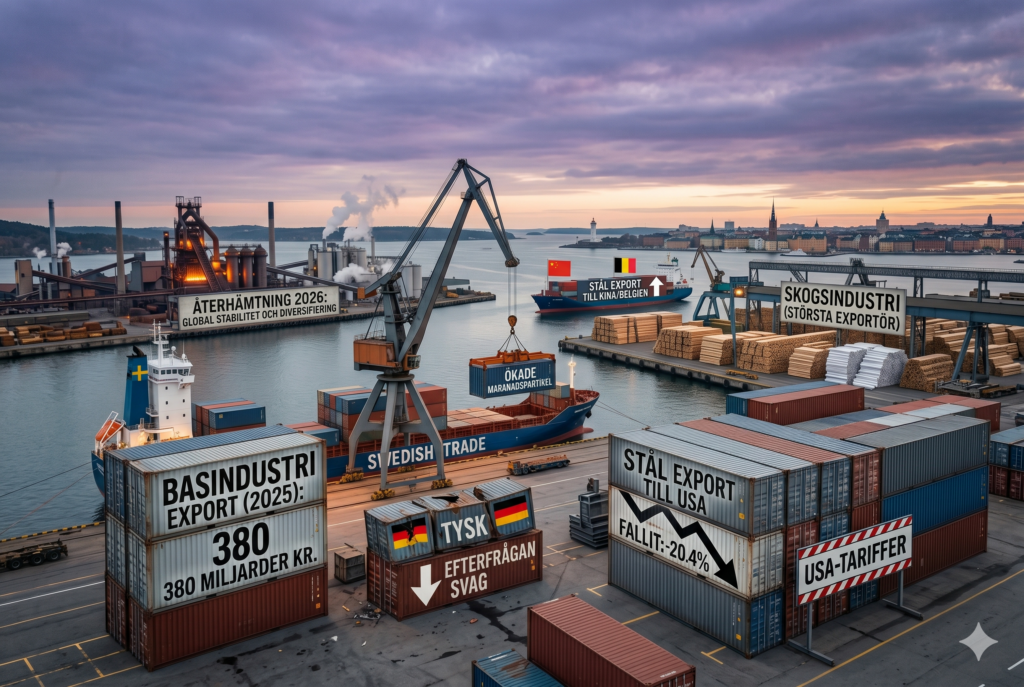
According to “Basindustrins export 2025” published by Industriarbetsgivarna, Sweden’s base industry remains one of the country’s most important economic pillars. Around 90% of total production is exported, underlining the sector’s major dependence on foreign demand. In 2025, the sector’s total export value reached approximately SEK 380 billion, representing a significant share of Swedish goods exports.
Forest Products Still Lead the Sector
The largest contributor within Sweden’s base industry was the forest sector. Exports from the forest industry totaled around SEK 178 billion in 2025. It was followed by the steel and metal industry with exports worth SEK 151 billion, while mining and other non-metallic mineral products accounted for smaller shares.
Germany Remains Key but Demand Weakens
Germany continued to be Sweden’s most important export market in 2025. Roughly 14% of total base industry exports were shipped there, valued at more than SEK 54 billion. However, exports to Germany declined by 5.5% compared with the previous year, largely due to weaker demand from German manufacturing and broader structural problems in Europe’s largest economy.
U.S. Tariffs Hit Swedish Steel
The United States also became a more difficult market. Total exports to the U.S. fell by around 6% between 2024 and 2025. The sharpest blow came in steel, where export value dropped by 20.4% after higher American tariffs made Swedish steel less competitive. This shift illustrates how trade policy can quickly affect industrial supply chains.
U.S. Tariffs Hit Swedish Steel
The United States also became a more difficult market. Total exports to the U.S. fell by around 6% between 2024 and 2025. The sharpest blow came in steel, where export value dropped by 20.4% after higher American tariffs made Swedish steel less competitive. This shift illustrates how trade policy can quickly affect industrial supply chains.
Mixed Results Across Industries
Not every segment weakened. While the forest industry declined by 2.2%, and mining exports also slipped, the broader steel and metal category increased by 1.1% overall. The report said rising prices for copper, gold, silver, and other metals helped offset losses in steel shipments.
China Gains Importance
The report also showed that export shares to Belgium, Finland, and China have increased in recent years, while dependence on Germany, Norway, the United Kingdom, and the United States has eased somewhat. This suggests Swedish industry is gradually diversifying its international customer base.
2026 Outlook Depends on Global Stability
Industriarbetsgivarna warned that uncertainty surrounding international trade is likely to remain high in 2026. Currency movements, tariffs, slower European growth, and geopolitical risks could continue shaping Swedish export performance. For Sweden’s base industry, competitiveness and diversified markets will be decisive in the year ahead.
Mixed Results Across Industries
Not every segment weakened. While the forest industry declined by 2.2%, and mining exports also slipped, the broader steel and metal category increased by 1.1% overall. The report said rising prices for copper, gold, silver, and other metals helped offset losses in steel shipments.
China Gains Importance
The report also showed that export shares to Belgium, Finland, and China have increased in recent years, while dependence on Germany, Norway, the United Kingdom, and the United States has eased somewhat. This suggests Swedish industry is gradually diversifying its international customer base.
2026 Outlook Depends on Global Stability
Industriarbetsgivarna warned that uncertainty surrounding international trade is likely to remain high in 2026. Currency movements, tariffs, slower European growth, and geopolitical risks could continue shaping Swedish export performance. For Sweden’s base industry, competitiveness and diversified markets will be decisive in the year ahead.
Follow us on LinkedIn!
Follow us on LinkedIn!
Would you like to sell your products or services worldwide?
Schedule an appointment with our international sales team
Would you like to sell your products or services worldwide?
Schedule an appointment with our international sales team