Swiss Economic Outlook Weakens as KOF Barometer Falls in March
Unexpected drop below the long-term average signals softer momentum for Switzerland’s economy
Swiss Economic Outlook Weakens as KOF Barometer Falls in March
Unexpected drop below the long-term average signals softer momentum for Switzerland’s economy
PUBLISHED April 28, 2026
A Sharp Decline in March
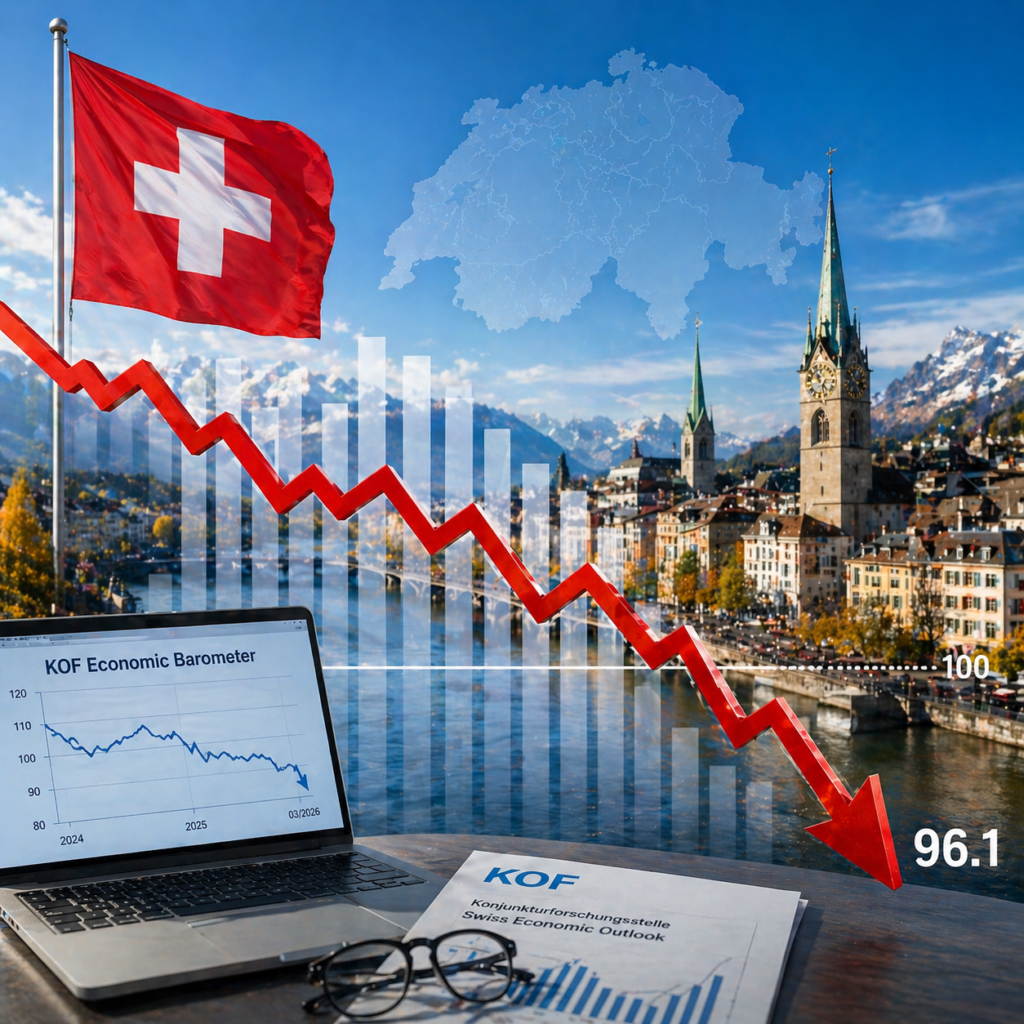
According to “KOF-Konjunkturbarometer März 2026: Schweiz Rückgang” published by Bluewin.ch, Switzerland’s economic expectations deteriorated significantly in March 2026. The KOF Economic Barometer fell by 7.7 points to 96.1, marking a notable setback after previous stability.
Below the Long-Term Average
The latest reading pushed the indicator below its long-term average level of 100 points. Bluewin reported that this threshold had last been breached following the tariff shock in August and September 2025. Falling below this level is generally seen as a sign of weaker near-term economic momentum.
Economists Were Surprised
The decline came as an unexpected result for analysts. According to the report, economists surveyed beforehand had expected the barometer to remain in a range between 100 and 104 points, meaning the actual outcome was clearly weaker than forecasts suggested.
Broad-Based Weakness Emerges
Bluewin noted that the slowdown was not isolated to one area of the economy. The KOF Institute said both production-side and demand-side indicators reflected a weaker outlook, suggesting a more widespread cooling in economic expectations.
Broad-Based Weakness Emerges
Bluewin noted that the slowdown was not isolated to one area of the economy. The KOF Institute said both production-side and demand-side indicators reflected a weaker outlook, suggesting a more widespread cooling in economic expectations.
Manufacturing and Foreign Demand Hit Hardest
Among the most affected categories were indicators linked to the manufacturing sector and foreign demand. This is especially relevant for Switzerland, where exports and industrial production remain important drivers of growth.
Why the Indicator Matters
The KOF Economic Barometer is considered a leading indicator designed to estimate how the Swiss economy may perform in the near future. Because it combines a wide range of economic data, it is closely watched by businesses, investors, and policymakers.
Outlook for the Coming Months
The March reading suggests Switzerland may face a softer economic phase in the near term if confidence does not recover quickly. Whether the setback proves temporary or more persistent will likely depend on foreign demand, industrial activity, and broader global market conditions.
Manufacturing and Foreign Demand Hit Hardest
Among the most affected categories were indicators linked to the manufacturing sector and foreign demand. This is especially relevant for Switzerland, where exports and industrial production remain important drivers of growth.
Why the Indicator Matters
The KOF Economic Barometer is considered a leading indicator designed to estimate how the Swiss economy may perform in the near future. Because it combines a wide range of economic data, it is closely watched by businesses, investors, and policymakers.
Outlook for the Coming Months
The March reading suggests Switzerland may face a softer economic phase in the near term if confidence does not recover quickly. Whether the setback proves temporary or more persistent will likely depend on foreign demand, industrial activity, and broader global market conditions.
Follow us on LinkedIn!
Follow us on LinkedIn!
Would you like to sell your products or services worldwide?
Schedule an appointment with our international sales team
Would you like to sell your products or services worldwide?
Schedule an appointment with our international sales team