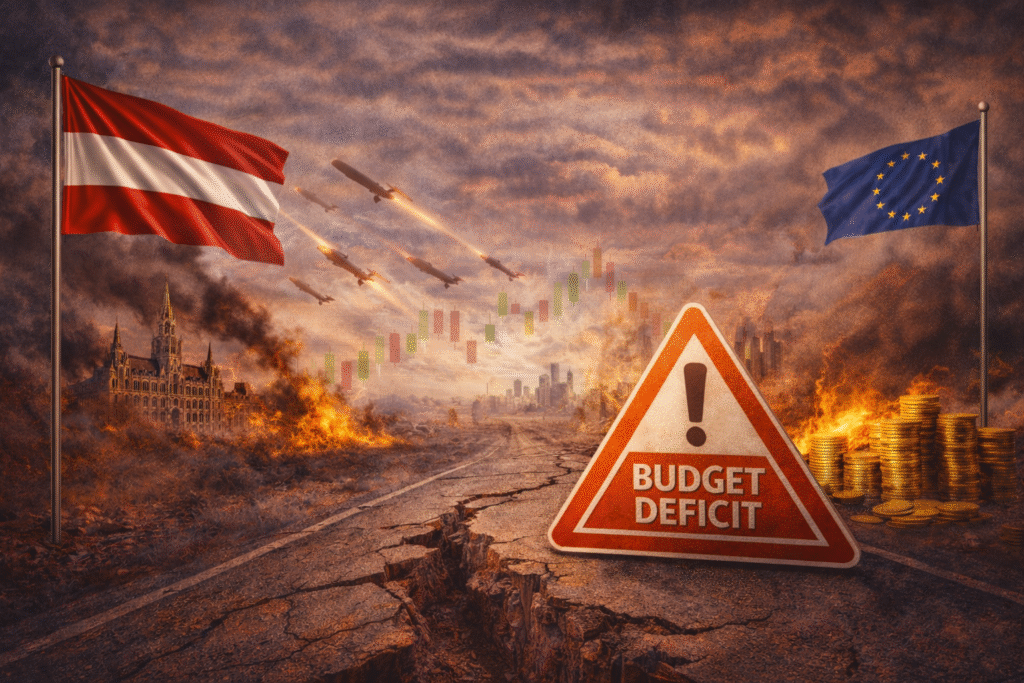
OECD Warns of Slowing Growth and Fiscal Challenges in Austria
Economic Recovery Faces Risks as Budget Deficit and External Pressures Persist
OECD Warns of Slowing Growth and Fiscal Challenges in Austria
Economic Recovery Faces Risks as Budget Deficit and External Pressures Persist
PUBLISHED March 27, 2026
OECD Assessment Highlights Fragile Recovery
According to a report presented by the OECD and covered by ORF, Austria’s economy has recently shown signs of recovery after two years of declining performance, with 2025 bringing a modest improvement in economic activity. However, this recovery remains fragile, and new risks are emerging that could slow down growth in the near future.
Geopolitical Tensions Threaten Economic Stability
One of the main concerns highlighted in the report is the impact of ongoing geopolitical tensions, particularly the conflict in the Middle East. These developments are expected to weigh on economic growth and may contribute to renewed inflationary pressures. As a result, Austria’s economic outlook remains uncertain despite recent signs of stabilisation.
Budget Deficit Remains a Central Issue
A key challenge for Austria’s economic policy is the reduction of the budget deficit. According to the report, the deficit is expected to return to the European Union’s threshold of three percent by 2028. This target reflects broader fiscal consolidation efforts, but achieving it will require sustained policy measures over the coming years.
Doubts Over Current Consolidation Measures
Despite the government’s plans, there is growing skepticism about whether the current measures will be sufficient. The Fiscal Council has expressed doubts that the existing consolidation steps will achieve the desired outcome. This has intensified the debate around additional fiscal adjustments and the need for more decisive action.
Doubts Over Current Consolidation Measures
Despite the government’s plans, there is growing skepticism about whether the current measures will be sufficient. The Fiscal Council has expressed doubts that the existing consolidation steps will achieve the desired outcome. This has intensified the debate around additional fiscal adjustments and the need for more decisive action.
Proposed Measures to Reduce the Deficit
In response to these concerns, the Fiscal Council has outlined several potential measures aimed at reducing the deficit. Among the most impactful proposals are the abolition of the family bonus, adjustments to value-added tax policies, and potential savings in pension expenditures. These suggestions highlight the scale of the fiscal challenge and the difficult decisions that may lie ahead.
Balancing Growth and Fiscal Discipline
The situation presents a complex balancing act for policymakers, who must support economic growth while also ensuring fiscal sustainability. While further consolidation measures may help reduce the deficit, they could also have implications for households and overall economic activity. This tension underscores the difficulty of managing economic policy in the current environment.
Outlook: Uncertainty Remains
Looking ahead, Austria’s economic trajectory will depend on both domestic policy decisions and external developments. The OECD assessment, as reported by ORF, suggests that while recovery is underway, it remains vulnerable to shocks and structural challenges. The coming years will be decisive in determining whether Austria can achieve stable growth while bringing its public finances under control.
Proposed Measures to Reduce the Deficit
In response to these concerns, the Fiscal Council has outlined several potential measures aimed at reducing the deficit. Among the most impactful proposals are the abolition of the family bonus, adjustments to value-added tax policies, and potential savings in pension expenditures. These suggestions highlight the scale of the fiscal challenge and the difficult decisions that may lie ahead.
Balancing Growth and Fiscal Discipline
The situation presents a complex balancing act for policymakers, who must support economic growth while also ensuring fiscal sustainability. While further consolidation measures may help reduce the deficit, they could also have implications for households and overall economic activity. This tension underscores the difficulty of managing economic policy in the current environment.
Outlook: Uncertainty Remains
Looking ahead, Austria’s economic trajectory will depend on both domestic policy decisions and external developments. The OECD assessment, as reported by ORF, suggests that while recovery is underway, it remains vulnerable to shocks and structural challenges. The coming years will be decisive in determining whether Austria can achieve stable growth while bringing its public finances under control.
Follow us on LinkedIn!
Follow us on LinkedIn!
Would you like to sell your products or services worldwide?
Schedule an appointment with our international sales team
Would you like to sell your products or services worldwide?
Schedule an appointment with our international sales team