German Producer Prices Drop Sharply in February 2026
Energy Costs Drive Decline Despite Rising Prices in Key Industrial Segments
German Producer Prices Drop Sharply in February 2026
Energy Costs Drive Decline Despite Rising Prices in Key Industrial Segments
PUBLISHED March 27, 2026
A Significant Year-on-Year Decline
According to data released by the Federal Statistical Office (Destatis), producer prices of industrial products in Germany were 3.3% lower in February 2026 compared to the same month a year earlier. This marks a continued downward trend in industrial pricing and reflects easing cost pressures across parts of the economy. On a monthly basis, prices also declined by 0.5%, further reinforcing the ongoing adjustment in the pricing environment.
Energy Prices as the Central Factor
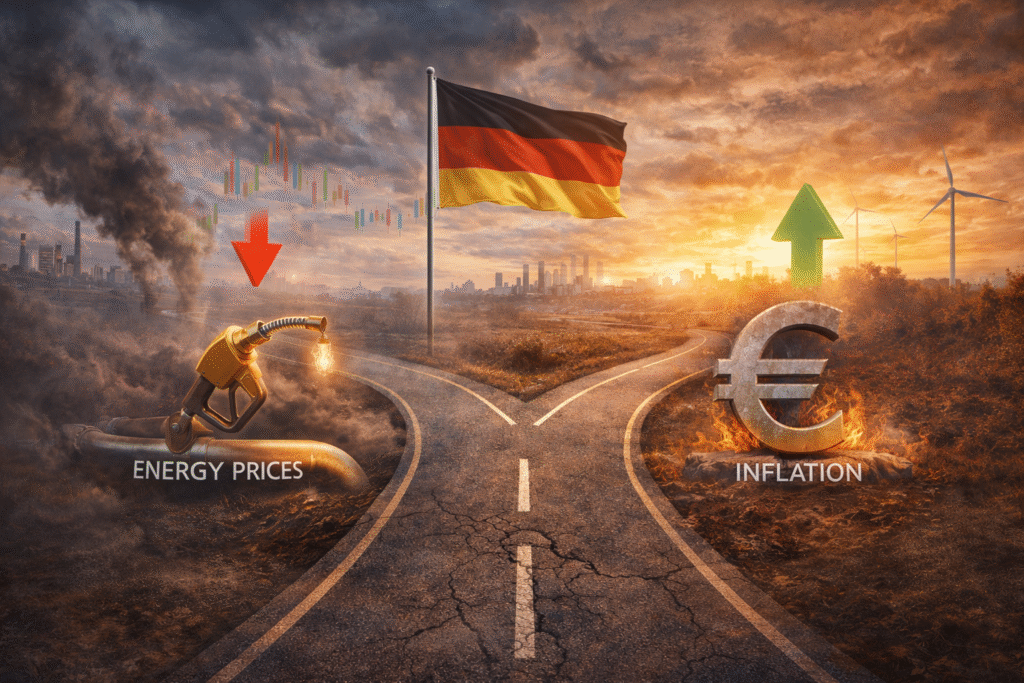
The primary reason behind the decline remains the sharp drop in energy prices, which have had the strongest impact on the overall index. Energy costs were significantly lower than a year earlier, falling by double-digit percentages and pulling the overall producer price level downward. Among energy components, natural gas and electricity recorded particularly notable decreases, contributing heavily to the overall trend.
Diverging Trends Across Product Categories
Despite the overall decrease, price developments across industrial sectors were far from uniform. While energy and certain consumer goods became cheaper, other categories showed clear increases. Prices for capital goods, such as machinery and vehicles, rose moderately compared to the previous year, indicating ongoing demand and cost pressures in investment-related industries. Similarly, durable consumer goods also recorded price increases, highlighting the mixed nature of current price developments.
Consumer Goods Show Mixed Signals
In contrast, consumer goods overall became slightly cheaper compared to the previous year, largely driven by falling food prices. However, this category also revealed significant internal differences. While some products, such as butter and pork, became considerably less expensive, others, including beef and coffee, experienced notable price increases. These contrasting movements illustrate how supply conditions and market dynamics continue to vary widely even within the same product group.
Consumer Goods Show Mixed Signals
In contrast, consumer goods overall became slightly cheaper compared to the previous year, largely driven by falling food prices. However, this category also revealed significant internal differences. While some products, such as butter and pork, became considerably less expensive, others, including beef and coffee, experienced notable price increases. These contrasting movements illustrate how supply conditions and market dynamics continue to vary widely even within the same product group.
Rising Costs in Intermediate Goods
Another important development can be observed in the prices of intermediate goods, which increased compared to the previous year. This rise was largely driven by higher metal prices, particularly for precious metals and copper products. At the same time, certain raw materials, including iron and steel, became slightly cheaper, again highlighting the uneven distribution of price changes across industrial inputs.
Implications for Inflation Trends
The decline in producer prices is often interpreted as a signal of easing inflationary pressures in the broader economy. As producer prices reflect costs at an early stage of the production process, sustained decreases may eventually influence consumer price developments. However, the persistence of rising prices in several categories suggests that inflationary pressures have not fully disappeared and may continue to affect certain sectors.
A Complex Economic Outlook
Overall, the latest data points to a complex economic situation in Germany, where falling energy costs are helping to reduce overall price levels, but underlying pressures remain in many areas. The figures released by Destatis underline that the current phase is not characterized by uniform deflation, but rather by a rebalancing of price dynamics across sectors. The coming months will be crucial in determining whether the downward trend in producer prices continues or stabilizes at a new level.
Rising Costs in Intermediate Goods
Another important development can be observed in the prices of intermediate goods, which increased compared to the previous year. This rise was largely driven by higher metal prices, particularly for precious metals and copper products. At the same time, certain raw materials, including iron and steel, became slightly cheaper, again highlighting the uneven distribution of price changes across industrial inputs.
Implications for Inflation Trends
The decline in producer prices is often interpreted as a signal of easing inflationary pressures in the broader economy. As producer prices reflect costs at an early stage of the production process, sustained decreases may eventually influence consumer price developments. However, the persistence of rising prices in several categories suggests that inflationary pressures have not fully disappeared and may continue to affect certain sectors.
A Complex Economic Outlook
Overall, the latest data points to a complex economic situation in Germany, where falling energy costs are helping to reduce overall price levels, but underlying pressures remain in many areas. The figures released by Destatis underline that the current phase is not characterized by uniform deflation, but rather by a rebalancing of price dynamics across sectors. The coming months will be crucial in determining whether the downward trend in producer prices continues or stabilizes at a new level.
Follow us on LinkedIn!
Follow us on LinkedIn!
Would you like to sell your products or services worldwide?
Schedule an appointment with our international sales team
Would you like to sell your products or services worldwide?
Schedule an appointment with our international sales team